|
|
2000 | 2001 | 2002 | 2003 | 2004 | 2005 | 2006 | 2007 | 2008 | 2009 | 2010 | 2011 | 2012 | 2013 | 2014 | 2015 | 2016 | 2017
January | February | March | April | May | June | July | August | September | October | November | December
|
New Article: To Settle Mars |
| A habitat on Mars.
Credit: Jason Archer |
Frank's done it again. Frank Stratford, author of several other articles on Red Colony, has submitted To Settle Mars,
an article discussing everything from the current advances being made
toward human colonization of Mars to the rockets that we will need to
get us there. This article offers a great overview of the first few
missions to Mars, in an upfront-and-simple style of writing that makes
Frank's work so enjoyable. Here's a snippet:
Some of the other major challenges to be dealt with in the first
years on Mars will be the creation and successful maintenance of food
production, water supplies, recycling efficiency and production of
energy for the ongoing viability and growth of any first settlement.
Most likely the first and most practical energy source could be nuclear
and most definitely solar. Any greenhouse component to a future base
will utilise the latest in genetically modified plants and will rely
heavily on the valuable lessons learnt through years of experimentation
with the growth of plants in Low Earth Orbit missions from the shuttle
and I.S.S.
@ 0:36 EST
(permanent link) |
|
Researchers Try to Ease Stress on Martian Plants |
 | Pyrococcus furiosus.
Credit: Henry Aldrich, University of Florida/NASA |
Humans deal with stress in a variety of ways. Some stress can be beneficial, provoking responses to eliminate dangers and achieve goals. Prolonged stress can be severely harmful, and can even cause death.
Plants have the same problems. When they experience stress, they release O2-, or superoxide, which acts to make the rest of the plant more resistant to new threats - and slow down or stop ordinary processes as the plant copes with the danger.
On Mars, plants that humans would bring, whether to use for survival or to aid in terraforming, are most likely going to be under severe, prolonged stress. Under these conditions, plants would have stunted growth and might even fail entirely. So now NASA researchers are trying to stop this stress response.
Using genes from Pyrococcus furiosis, a microbe that lives in ocean vents, the researchers hope to augment plants' natural mechanisms to eliminate superoxide, and at the same time get around plant mechanisms to slow detoxification.
If successful, we can expect faster-growing plants that might stand a chance on Mars. However, this modification will most likely come with some adverse effects, such as making the plants more vulnerable to certain threats. Only time will tell.
(More info: NASA)
@ 19:59 EST
(permanent link) |
|
Hopping Aircraft |
Pioneer Astronautics, which Robert Zubrin heads, has developed a craft
capable of using CO2
as its main propellant. The craft compresses the
gas to make it liquid and then sends it through a preheated pellet bed,
causing the gas to expand and produce thrust. With carbon dioxide as
the main propellant, it could obtain fuel from the atmosphere of Mars,
which is mainly composed of CO2.
"The flight vehicle could
either be a ballistic vehicle...or a winged airplane that would take
off
and land like a Harrier, then transition to horizontal flight," said
Zubrin. A winged craft, the more efficient option, would be able to
travel
farther, while a ballistic craft would only cover a few miles, with an
initial launch thrust and then a fall like a projectile. After a month
of flight the craft would be recalled to reheat the pellets and refuel
(although it can refuel while on duty). The craft has already made a
1660-foot flight. "We call her 'Mars Ship One,'" Dr. Zubrin said, "because
the desert skies of Mars are its oceans, and she is the first craft
designed to navigate them." Mars Ship One has a wingspan of 14 feet and weighs
118 pounds. The craft will be on public display August 11-14, 2005 at the
8th International Mars Society Convention.
(More info: Space.com, Pioneer Astronautics)
@ 13:27 EST
(permanent link) |
|
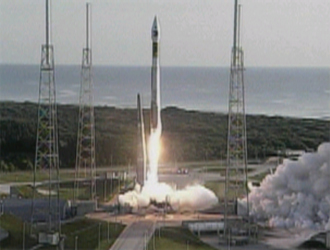
Mars Reconnaissance Orbiter Lift Off |
| MRO's lift-off.
Credit: NASA/KSC |
At 7:43:00 a.m EDT, from Complex 41, the Mars Reconnaissance Orbiter
lifted off today. The MRO is NASA's next mission to Mars and is
expected to return more data than all past Mars missions combined. The
orbiter has a 13-month journey ahead of it (7 months cruise and 6
months of aerobraking). The orbiter will return close-up photography,
analyze minerals, look for subsurface water, trace how much dust and
water are distributed in the atmosphere, and monitor daily global
weather. The camera on the MRO has about 1m resolutions, much greater
than any other orbiter. The MRO will also be the first craft in the
"interplanetary Internet." This will allow a network or relays for
other craft to use to communicate with Earth. It will also test Ka-band
radio. This might allow it to use less power and have greater
performance than previous radios. Godspeed to the orbiter and its team.
(More info: NASA)
@ 9:17 EST
(permanent link) |
New Article: Mars as an Investment in Earth |
 | Mars can work for Earth.
Credit: Unknown |
Space has always spawned many spinoff products and technologies here on Earth, but can you imagine what colonizing another planet would do for the advancement of science? Steven Wintergerst has submitted a new article entitled Mars as an Investment in Earth. The article covers the many scientific fields that would be greatly enhanced if we were to colonize Mars. From robotics to medicine to recycling, the Earth (and the human race) would benefit. He does however criticize the notion that the transporation of rare metals can be a means of sustaining a popular colonization movement. In the process Steven advocates the careful conservation of materials on Mars. Here's a snippet:
It is cheaper, and easier to recycle metals on earth than it is to mine them. Unlike helium, or hydrogen, once a metal is “used” on earth, it does not boil off into space, but merely becomes a recyclable waste material. Even if we should find some way of entirely disposing of our metallic resources, our active plate tectonics, and huge iron-nickel core ensure us with a replenishing supply of metals.
On Mars, the iron-nickel core is much smaller, and inactive. Obtaining metal from anywhere but near-surface deposits will require enormous digging on a scale that is not made much easier by the lower gravitational pull of the planet.
Since excavation equipment tends to be massive, shipping it to Mars will be difficult. Much of this equipment also requires precision manufacturing for optimal performance. Thus, it would be far more desirable on Mars if the items used there could be re-used, or recycled with ease.
@ 19:46 EST
(permanent link) |
|
Wednesday, August 17, 2005 | |
|
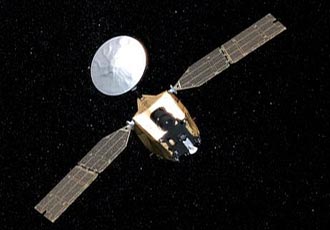
Mars Reconnaissance Orbiter Doing Well |
| Artist's conception of the Mars Reconnaissance Orbiter.
Credit: NASA |
NASA has announced that the Mars Reconnaissance Orbiter has nearly passed its
first in-flight test, of the MARs Color Imager (MARCI), built by Malin Space Science Systems,
a company that has been extremely active in recent Mars missions. While
the pictures, a view of Earth and the Moon that only occupies a few
pixels of the high-resolution pictures, have not been analyzed yet,
everything else worked flawlessly. This is good news for an important
mission.
Upon beginning the science phase of its mission in November
2006, the MRO will return hopefully spectacular images of the surface
from low Martian orbit, as well as analyze ozone levels in the
atmosphere and act as a relay for other missions, such as Odyssey and
the MGS do today for the Mars Exploration Rovers. All told, the MRO
should return several times more data than all previous missions to
Mars combined.
(More info: Red Nova, NASA's MRO Site)
@ 20:46 EST
(permanent link) |
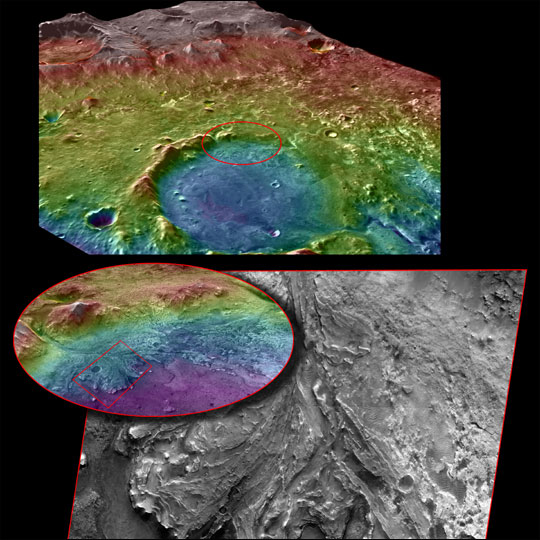
New Evidence for Long-Term Water, Dried Suddenly |
| Pictures of Nili Fossae deltas.
Credit: GRL/NASA |
Two Brown University researchers have reported in the American Geophysical Union journal Geophysical Research Letters that they have evidence for long-term water in the Nili Fossae region, in Syrtis Major (MC-13 in the Gazetteer of Planetary Nomenclature). While the area appears to have been only wet for thousands of years, it once contained a significant amount of water, being about the size of Lake Tahoe, with both inflow and outflow channels.
On Earth when dry periods occur in such regions the inflow channels must begin to carve their way through their own deposits as they decline, leaving deep channels into the body of water. This did not occur here, leading the authors to conclude that the area must have dried rapidly to avoid this.
(More info: Discovery Channel, Geophysical Research Letters [Requires subscription, look at current publications])
@ 21:01 EST
(permanent link) |
|
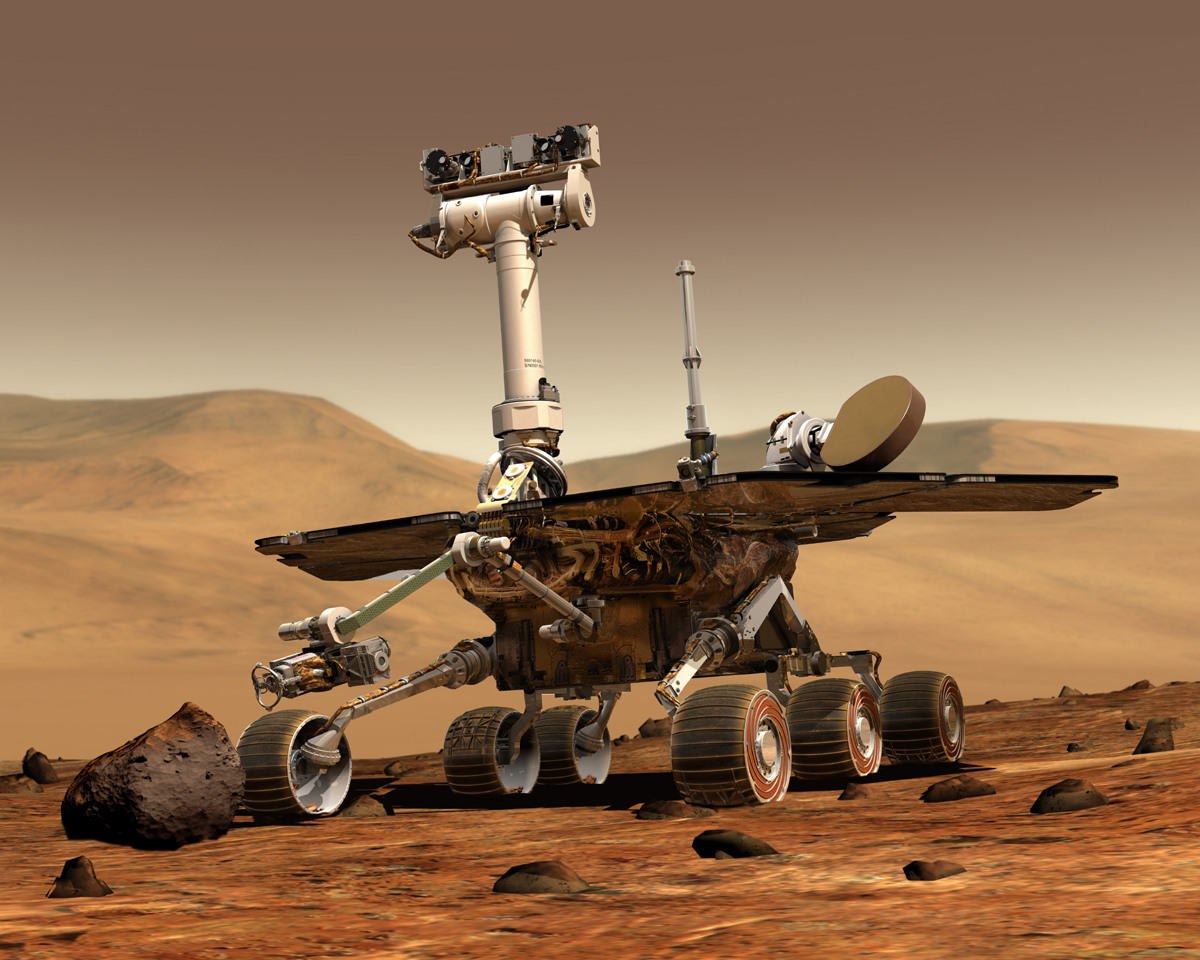
NASA to Release Full Panorama of View from Husband Hill |
| Artist's conception of one of the Mars Exploration Rovers.
Credit: NASA/JPL/Daniel Maas |
We've received a tip from member Marsman that NASA is planning on releasing a panorama taken by Spirit from the summit of Husband Hill, one of the hills named after the lost Columbia astronauts. Spirit climbed the hill over a period of months, exploring along the way. The view is sure to be spectacular, and the first of its kind. Previously all views of Mars have been from orbit or from very close to the ground. This bird's-eye view will be truly remarkable, and is more like what a human geologist would do when trying to assess nearby terrain. The fact that Spirit made it to the top at all testifies to the remarkable ingenuity of the Mars Exploration Rover team and the advancement of remote technology.
@ 15:41 EST
(permanent link) |
|
New Article: On the Possibility of Terraforming Mars |
 | A terraformed Mars.
Credit: Mars News |
Martyn Fogg, long-time terraforming expert and a leader in the field of planetary science, has submitted one of his articles, On the Possibility of Terraforming Mars. Dr. Fogg has published many articles on terraforming over the years, and his research has helped develop many of today's most accepted theories on terraforming. Here's a snippet of his article:
If space exploration can be said to have a purpose beyond that of reconnaissance and understanding of the universe, it is expressed by many involved in the space business as space settlement: the founding of new branches of civilisation remote from the Earth. However, the technical issues involved in a permanent stay remote from our salubrious home-world are far from trivial. Initial missions such as visits to other planets, followed by outposts and pioneering settlements, are all likely to have their life-support subsidised in the form of machinery and consumables supplied from Earth. This strategy will not be sustainable for long. To achieve growth and permanency, space-based civilisations must harness local resources in autonomous and stable bioregenerative life-support systems, energised by the sun.
@ 22:43 EST
(permanent link) |
|
Hurricane Katrina Pounds the Southern US |
 | Hurricane Katrina
Credit: AP/CNN |
Hurricane Katrina has totally devastated the southern Gulf coast of the
United States. Hundreds of people are feared dead. Two levees have
broken around New Orleans and 80% of the city is underwater.
Floodwaters are only rising. Fresh water and electricity may not be
restored for weeks. Refugees are being evacuated, though all major
highways leading into New Orleans are completely destroyed.
While not Mars-related news, we feel that we must take this
opportunity to try to raise awareness of the various relief funds that
are available. If you would like to help, visit a local
Lowe's hardware store to have your donation matched up to $1 million
dollars. Additionally, the Red Cross is launching the largest relief
effort in its history. You can visit their website.
@ 17:10 EST
(permanent link) |
2000 | 2001 | 2002 | 2003 | 2004 | 2005 | 2006 | 2007 | 2008 | 2009 | 2010 | 2011 | 2012 | 2013 | 2014 | 2015 | 2016 | 2017
January | February | March | April | May | June | July | August | September | October | November | December
|
|