|
|
2000 | 2001 | 2002 | 2003 | 2004 | 2005 | 2006 | 2007 | 2008 | 2009 | 2010 | 2011 | 2012 | 2013 | 2014 | 2015
January | February | March | April | May | June | July | August | September | October | November | December
|
Wednesday, November 3, 2004 | |
|
George W. Bush Wins Re-Election |
 | George W. Bush
Credit: AP Photo |
George W. Bush will serve another four-year term as President of the United States after winning Tuesday's election against Massachusetts senator, John Kerry. Bush, supporting a new government-based Space Initiative in January, had vowed to make human space exploration a priority in his second term.
The race fueled heated debates over the last months in the United States and elsewhere and led to the highest voter turnout in a generation. The election was also very close, finally decided by a single state's electoral votes, although the Republican, Bush commanded a 3.5 million lead in the popular vote. The scene was very much reminiscent of the hectic 2000 Presidential election, which Red Colony tracked. The election was finally awarded to George Bush this afternoon.
@ 14:49 EST
(permanent link) |
Britain Prepares Beagle 3 Lander |
 | Artist's conception of Beagle 2: Evolution descending.
Credit: Unknown (BBC) |
Britain is preparing a new Beagle lander as a replacement for the failed Beagle 2. To be included as part of the ESA's Aurora program and as a precursor to the ExoMars project, it will be called "Beagle 2: Evolution" and will not simply be a copy of the original lander. Featuring a new airbag system, advanced solar panels that need only half the surface area of the old ones, 60% more battery life, it will be a significant improvement over the old lander. And "it" is a misnomer, as two of them will be launched and dropped onto the surface of Mars, similar to the ongoing Mars Exploration Rovers.
(More info: BBC)
@ 18:46 EST
(permanent link) |
|
More Evidence for Glaciers |
 | Tithonium Chasma, looking east. The chasma is part of the Valles Marineris canyon system.
Credit: ESA |
Mars Express's High Resolution Stereo Camera (HRSC) has
returned 3D images that are at an incredible resolution of 50m and that
have revealed important new evidence for glaciers on Mars. The images
allow geologists to have a
better picture of how the surface evolved over time. "The images are
showing us a lot more evidence for recent water activity, and probably
recent ice deposits, than I'd previously thought," says John Murray,
one of the HRSC team members at Open University, Milton Keynes, UK.
Features that are similar to Earth's glacier-formed U-shaped valleys
with rubble in
them have been found on the Red Planet. The images also show that the
canyon floors are covered in
a dark, layered material, suggesting past volcanic activity.
On a side note, a powerful instrument on the Mars Express, the Mars Advanced
Radar for Subsurface and Ionosphere Sounding (MARSIS) that could find
water within a few kilometers below the surface, is still inactive.
Activating this device would mean that the orbiter would need to turn.
Simulations are being done to make sure this is safe for the craft.
(More info: Nature)
@ 20:41 EST
(permanent link) |
|
Saturday, November 6, 2004 | |
|
Notable Mars Researchers to Speak in Denver |
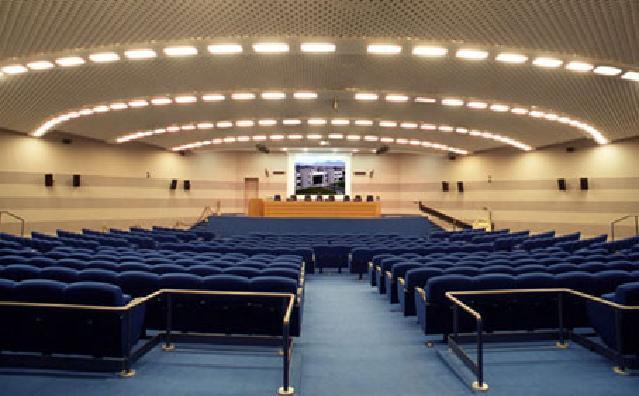 | Empty Lecture Hall
Credit: International Association of Environmental Mutagen Societies |
For those of you near Denver, Colorado, the Geological Society of America Annual Meeting is occurring on Tuesday the 9th at 7:30-9:00 PM at the Colorado Convention Center Ballroom in downtown Denver. No registration is required and it's free. Why is it interesting?
Well, lead Mars researchers from across the nation will be presenting speeches and answering questions from the audience. These include Dr. Michael Malin, designer of the Mars Global Surveyor camera, Dr. Plaut, who's heading the MARSIS component of the Mars Express mission, Dr. Christensen, principal investigator for the THEMIS instrument on the Mars Odyssey spacecraft, and Dr. McCleese, chief scientist of JPL's Mars program. Most notable, perhaps, is Dr. Steve Squyres, the head of the wildly successful Mars Exploration Rovers. Or perhaps I'm biased because I now work under him. Regardless, it's sure to be a very enlightening and enjoyable time if you can attend.
(More info: SpaceRef)
@ 0:12 EST
(permanent link) |
|
Friday, November 12, 2004 | |
|
Getting out of Endurance |
 | Burns Clift as seen on Sol 280
Credit: JPL/NASA |
The JPL team has decided to turn Opportunity around. The proposed route
out of the Endurance Crater was deemed too risky. "We've done a careful
analysis of the ground in front of Opportunity and decided to turn
around," said Jim Erickson, rover project manager at JPL, "to the
right, the slope is too steep -- more than 30 degrees. To the left,
there are sandy areas we can't be sure we could get across." Before
Opportunity retreats from its position, it will spend some time
examining "Burns" cliff, to help scientist tell weather or not there
was water or solely wind activity there. "We have pushed the vehicle
right to the edge of its capabilities, and we've finally reached a spot
where we may be able to answer questions we've been asking about this
site for months," said Dr. Steve Squyres. "But after we're done here,
it'll be time to turn around. Going any farther could cut off our line
of retreat from the crater, and that's not something anybody on the
team wants to do."
Spirit, half a planet away, is supposedly sending back false
information about its steering breaks. The team will disregard this
information and assume that Spirit is working. "We're going back to
using the full steering capabilities of Spirit," Erickson said.
(More info: JPL/NASA)
@ 10:16 EST
(permanent link) |
|
Saturday, November 13, 2004 | |
|
Mars Gullies Formed by Subsurface Water |
| Gullies on Mars, formed by water?
Credit: NASA/JPL/MSSS |
Researchers at NASA Ames Research Center have released findings that show that the much debated gullies on Mars are most likely formed by near-pure liquid water -- continuing today.
Although there has been some speculation as to whether or not carbon dioxide or other causes formed these features, it now appears most likely that present-day liquid water is the culprit. While the match still isn't perfect, no other theory comes as close.
If true, this find has several important implications. With liquid water nearby, these gullies could become desirable sites for manned missions. More importantly, however, they could be prime sites to look for signs of life on Mars. There are very few places, if any, on Earth where liquid water does not contain life.
(More info: Space.com)
@ 14:32 EST
(permanent link) |
|
Tuesday, November 16, 2004 | |
|
Possible Deltas Found on Mars |
| A possible delta on Mars
Credit: NASA |
Mars Global Surveyor has returned images that look surprisingly like
deltas at the end of rivers, which are caused by sedimentary deposits.
The images also show meanders, series of S-shaped curves of a stream
caused by sedimentary deposits and changing gradients. "Meanders are
key, unequivocal evidence that some valleys on early Mars held
persistent flows of water over considerable periods of time," said Dr.
Michael Malin of Malin Space Science Systems, San Diego, the operator
of the MGS's cameras. The fan is 13 by 11 km's in size. "This latest
discovery by the intrepid Mars Global Surveyor is our first definitive
evidence of persistent surface water," said Dr. Jim Garvin, NASA's Lead
Scientist for Mars Exploration. "It reaffirms we are on the right
pathway for searching the record of Martian landscapes and eventually
rocks for the record of habitats. Such localities may serve as key
landing sites for future missions, such as the Mars Science Laboratory
in 2009. These astounding findings suggest that 'following the water'
with Mars Global Surveyor, Mars Odyssey, and soon with the Mars
Exploration Rovers, is a powerful approach that will ultimately allow
us to understand the history of habitats on the red planet." As of now,
no liquid water has been found on the surface, but recent findings have suggested that there is a strong possibility for subsurface water and ice.
(More info: About
)
@ 10:00 EST
(permanent link) |
|
Thursday, November 18, 2004 | |
|
New Short Story: 2190 RC |
| A ship above Mars.
Credit: John Ridgway and Dan Dare |
Brunnen G has sent us a short story called 2190 RC. This exciting story of a soldier's preparation for battle has a history to serve as its own backstory. Here's a snippet:
In the time before counting, Mars had become the home of humanity. In shame we fled the dying Earth, saving what we could from the storm of our making. As refugees we landed here hidden in vast domes as the first Great and Terrible machines were built, changing Mars to a place where we might survive outside and flourish once more.
Men were also changing. The castes emerged. First came the warrior caste, strong and fearsome. Their pointed teeth, horns and need for raw meat separated them from society, and for a time they were outcasts, living in the wild places where life is hard and death comes swiftly.
Read it here.
@ 22:37 EST
(permanent link) |
2000 | 2001 | 2002 | 2003 | 2004 | 2005 | 2006 | 2007 | 2008 | 2009 | 2010 | 2011 | 2012 | 2013 | 2014 | 2015
January | February | March | April | May | June | July | August | September | October | November | December
|
|